
Jordan Medjool dates are grown in the Jordan Valley, one of several places in the world where the Medjool palm is grown commercially. Medjool itself originated in Morocco. So when a supplier offers you "Jordan Medjool", the word Medjool tells you the variety and the word Jordan tells you the country. Neither tells you the size, the grade or how the carton was stored, and those are what you pay for.
This guide covers what can be checked: where the fruit grows, how Medjool is sized, how it should be packed and labelled, and what one Malaysian wholesaler actually listed when it was checked in November 2026.
Where the Medjool palms in Jordan grow
Jordanian researchers describe Medjool plainly as "a significant plant, grown in Jordan". A 2026 study from Jordan's National Agricultural Research Centre tested pesticide residues on Barhi and Medjool, which it calls "two commercially important date palm cultivars", grown under arid Jordan Valley conditions over the 2024 and 2025 seasons. Another Jordanian study collected weeds from date palm orchards at Tal al-Ramil in the Central Jordan Valley and al-Twal in the Northern Jordan Valley, which places date orchards in both the central and northern parts of the valley.
The valley has two banks. A 2018 study looked at date palm cultivation in the Lower Jordan Valley of the West Bank and found it "economically achievable" in the Jericho-Al Ghoor district. A carton that says only "Jordan Valley" names a valley, not a country. If the country matters to your buyers, ask for it on the invoice and on the box.
Medjool is grown in many countries
The FAO's date palm handbook lists the main Medjool producers as the Coachella Valley and Bard in California, Morocco and Israel, with small amounts from Mexico, Namibia and South Africa. Published studies also describe Medjool, sometimes spelled Majdool, grown in the Ha'il region of Saudi Arabia and in Dakhla Oasis in Egypt.
So "Medjool" on a price list is a variety name, the same way "Ajwa" or "Sukari" is. Two cartons can both say Medjool and come from different continents.
Size grades for Medjool
Packhouses sort good fruit by size after the first quality sort, and FAO notes this step is "particularly important for varieties with large fruit such as Medjool". The handbook gives the size bands used in Israel, by weight of a single fruit:
| Size (Israel, per FAO) | Weight of one fruit |
|---|---|
| Jumbo | more than 23 g |
| Large | 18 g to 23 g |
| Medium | 15 g to 18 g |
The same handbook adds that "in other countries (for instance USA) other definitions" are used. In Malaysia, grade words such as Large, Jumbo and Super Jumbo are each importer's own size sorting, not an international standard. A Jordanian Jumbo and a Palestinian Jumbo are only comparable if you weigh a sample.
Size also depends on how the palm is managed. An Egyptian field trial found that removing a third of the fruit strands at the Kimri stage raised Medjool fruit weight by 10.44% compared with the control palms, and by more when combined with a calcium boron spray.
Taste, texture and why the skin matters
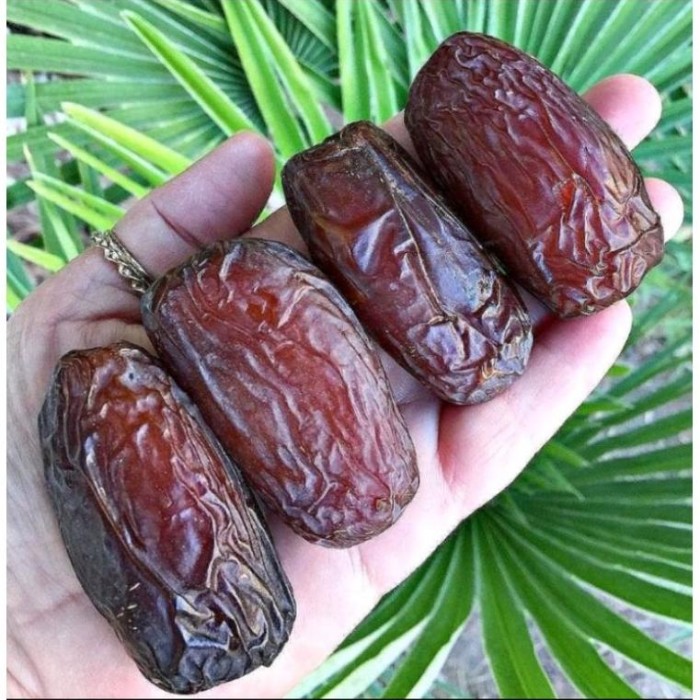
Medjool is large, very soft and has a rich caramel taste. FAO describes it as "a soft and delicate fruit with a thin skin", and notes that harming the skin may cause sugar crystallisation. At harvest, it says, growers take into account what clients want, which is large, soft fruit.
Skin matters for price too. FAO says skin separation is more serious in varieties such as Medjool, "significantly lowering the price for export fruit". When you open a sample carton of Jordan Medjool dates, look at how many fruits have skin lifting away from the flesh. That is a quality point you can check with your own eyes, unlike an origin claim.
How Medjool is packed and stored for wholesale
FAO lists the details that should be printed on export packaging: net weight, country of origin, who grew and packed it (with address), product and variety, and the category or grade. It also notes that "in most importing countries, the law demands that data such as weight, country of origin, quality and date of expiry, appear on the package". That list doubles as a checklist when a carton arrives.
For long-term storage, FAO says the temperature commonly used for several varieties "including Medjool is -18 °C". Our guide to keeping Medjool dates fresh covers storage once the fruit is in your hands, and the Medjool growth and harvesting guide explains what happens before it is packed.
Jordan's own researchers are also working on the export side. The 2026 Jordan Valley residue study set pre-harvest intervals for three pesticides on Medjool and Barhi based on international maximum residue limits, and described the work as contributing to "safe pesticide use guidelines for date palm production and export compliance". For a buyer, a supplier who can show residue test results for a lot is giving you more than a supplier who only names the country.
If you want to understand why a paper trail back to the packhouse matters, this piece on tracing the origin of a dates consignment walks through the idea.
Jordan Medjool dates in Malaysia: what was on offer
Every date sold in Malaysia is imported. When one Malaysian wholesaler's list was checked in November 2026, it carried nine Medjool listings, and every one was labelled Palestine. None was labelled Jordan. These five were in stock:
| Pack (labelled Palestine) | Listed price | Per kilo |
|---|---|---|
| Premium Jumbo, 5kg carton | RM280 | RM56.00 |
| Jumbo, 12 × 500g | RM355 | RM59.17 |
| Jumbo, 8 × 900g | RM448 | RM62.22 |
| Super Jumbo, 5kg carton | RM315 | RM63.00 |
| Jumbo, 900g box | RM70 | RM77.78 |
All three Large listings on that list were out of stock, as was a second Jumbo 12 × 500g line. So if you are quoted Jordan Medjool dates in Malaysia, compare them against Palestinian Jumbo at roughly RM56 to RM63 a kilo in bulk, and ask the supplier to put the country of origin in writing. The full breakdown of grades and pack sizes is in our Medjool wholesale prices per kilo guide.
Questions buyers ask
Are Jordan and Palestinian Medjool different varieties?
No. Both are the Medjool cultivar. What differs is where the palm grew, how the orchard was managed and who packed and graded the fruit.
Did Medjool originate in Jordan?
No. Medjool originated in Morocco. Jordan is one of several countries that now grow it.
How do I know a carton is really from Jordan?
You can't tell from the fruit. Ask for the country of origin on the carton and the invoice, and for the packer's name and address, which FAO lists among the details export packaging should carry.
What size should I ask for?
Ask for the fruit weight band, not just the word Jumbo. Under the Israeli bands FAO quotes, Jumbo means more than 23 g a fruit, but your supplier's Jumbo may be sorted differently.
Buying Jordan Medjool dates well comes down to getting the country of origin and the size band in writing. The fruit will tell you the rest when you open a sample.